
Sridhar Mukkandi
Applied AI engineer · Founder of Tarkika · Author of Decide, Don't Generate · Creator with 280K+ followers
Most of what an AI agent does isn't writing. It's deciding. Sridhar writes about getting that part right.
Sridhar Mukkandi is an applied AI engineer who builds AI agents and the decision systems behind them. He specialises in retrieval systems (RAG and GraphRAG), multi-agent orchestration with MCP, and production LLM workflows in Python and FastAPI.
He leads a team of 15 engineers, sets the technical direction across their projects and runs weekly generative AI training, from LLMs to RAG to MCP to agentic systems. He has taken AI proofs of concept from prototype to production for government and enterprise clients, including a bilingual, voice-driven complaint-intake agent for a city police department that reached 94% accuracy.
His book, Decide, Don't Generate: Jev, System One Models, and the Decision Layer of Agentic AI, is about the step most AI tutorials skip: turning a model's number into an action. It walks through calibrated probabilities, thresholds set by what each mistake costs, and a clear rule for when a machine should hand a case to a person, all built around one night shift in a security team.
He founded Tarkika, the press and school for AI builders, to make the hard parts of building with AI clear, and started it while still completing his B.Tech in Artificial Intelligence. He writes The Sunday Letter, a free weekly essay with the code, and edits The Signal, a daily AI news brief where every story is checked by a person.
He has been building an audience online since 2020: 100K followers by the age of 18, and more than 280,000 today across Instagram and YouTube.
What he's built
A bilingual, voice-driven complaint-intake agent for a city police department (94% accuracy), a platform for municipal citizen services, and an 8-agent family assistant. All three are moving from proof of concept to production with client sign-off.
Work on an enterprise agent platform in Rust with fine-grained authorization (RBAC, ABAC, ReBAC), and an AI-triaged email-to-agent workflow shipped end to end with 641 of 641 tests passing and two production defects caught before release.
An AI-enabled work management portal and a hiring portal on an 8-service backend, plus a generative AI content pipeline combining prompt engineering, multimodal generation and backend integration.
A multi-role agentic assistant with a 5-round autonomous MCP orchestration loop, Neo4j GraphRAG retrieval, ChromaDB semantic search, cross-encoder reranking and full LLM observability, including early detection of at-risk students.
An autonomous customer-support agent using MCP tool orchestration, RAG-grounded retrieval, function calling, streaming responses and bounded conversational memory, tuned for reliability under concurrent load.
Weekly generative AI training for a team of engineers and their supervisors, and a 3-month mentorship track on RAG and agentic AI as lead of his college's AI club.
Skills
B.Tech in Artificial Intelligence (graduating 2027). Professional certifications in RAG and agentic AI, and in cloud AI fundamentals.
In his words
"Machines take the easy ends; people take the middle."
Decide, Don't Generate, Chapter 21
"Never put a threshold on a probability you haven't checked against recent outcomes."
The Sunday Letter, No. 01
"A policy that ignores capacity isn't a policy. It's a wish."
The Sunday Letter, No. 05
What he believes
Most of an AI agent's real work is choosing between a few options, not writing paragraphs. That part deserves its own model, its own tests and its own design.
A probability is only useful if its 80% happens about 80% of the time. Check calibration before you draw a single line.
Thresholds should come from what each mistake costs and how many people can review the rest, never from a default of 0.5.
The book
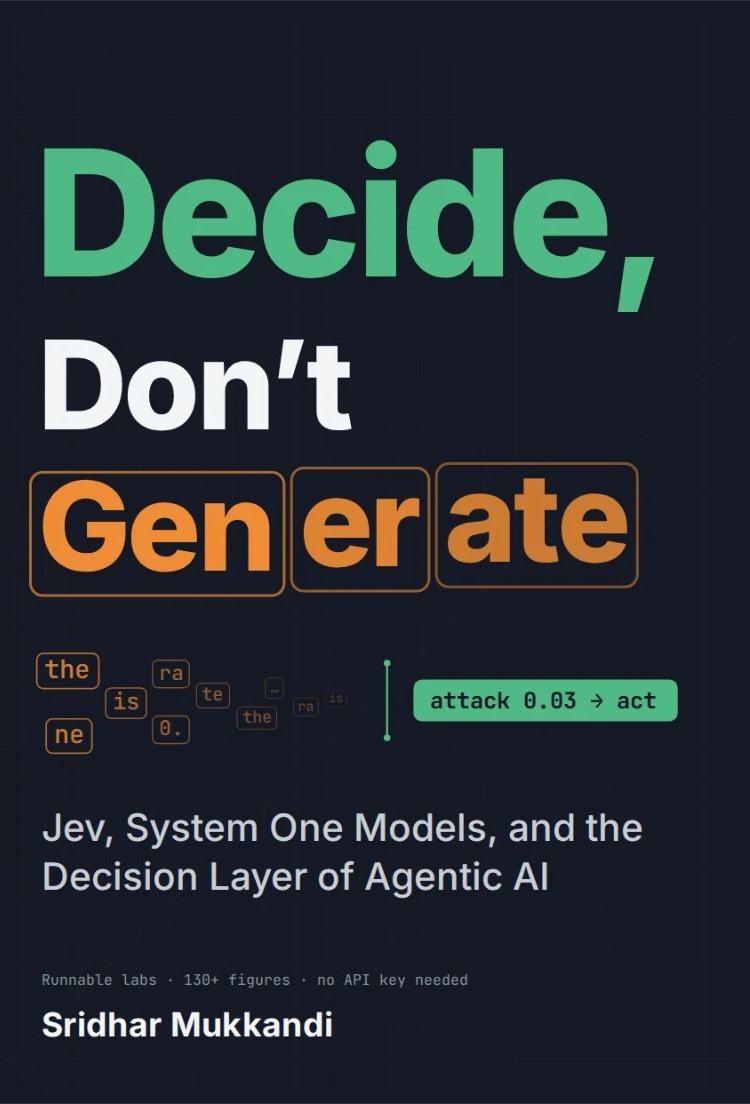 Decide, Don't GenerateJev, System One Models, and the Decision Layer of Agentic AI. 29 chapters in seven parts, 130+ figures and runnable labs that need no API key. Paperback available in India with free delivery and pay on delivery.
The Sunday Letter: recent essays
2026, so far
- Starts creating online
Grows an audience from scratch: 100K followers by 18, 280K+ today across Instagram and YouTube.
- Leads his college's AI club
Mentors students through a 3-month track on RAG and agentic AI.
- First generative AI role
Builds a generative AI content pipeline and a prompt library for a digital education platform.
- Two open-source agent systems
An LLM commerce support agent and a GraphRAG academic assistant, both built on MCP orchestration.
- Leads a team of 15 engineers
Sets technical direction, runs weekly generative AI training, and builds three AI systems that move toward production.
- The Sunday Letter begins
The first essay, "Why 0.5 is almost always the wrong threshold".
- Decide, Don't Generate takes shape
29 chapters in seven parts, from probability to a production decision service.
- Tarkika launches
The book goes on sale in India, and The Signal starts publishing daily AI news.
Work with Sridhar
On AI agents, decision systems and calibration, for conferences, meetups and college departments.
A two-day workshop for universities and teams: probability and calibration on day one, thresholds and agents on day two.
For companies that want AI systems which decide reliably, with lines drawn by cost and a person in the loop.
Write to hello@tarkika.com with the date, the audience and what you'd like covered.
Press kit
Sridhar Mukkandi is an applied AI engineer, the founder of Tarkika and the author of Decide, Don't Generate. He builds AI agents and retrieval systems, leads and trains a team of 15 engineers in generative AI, and has more than 280,000 followers across Instagram and YouTube.
Sridhar Mukkandi is an applied AI engineer who builds AI agents and the decision systems behind them, specialising in RAG and GraphRAG, multi-agent orchestration with MCP, and production LLM workflows in Python and FastAPI. He leads a team of 15 engineers, runs weekly generative AI training, and has taken AI systems from proof of concept to production for government and enterprise clients, including a bilingual voice-intake agent for a city police department that reached 94% accuracy. He is the author of Decide, Don't Generate: Jev, System One Models, and the Decision Layer of Agentic AI, and the founder of Tarkika, the press and school for AI builders, where he writes The Sunday Letter and edits The Signal. He started Tarkika while completing his B.Tech in Artificial Intelligence, and has built an audience of more than 280,000 followers across Instagram and YouTube since 2020.
Questions
Who is Sridhar Mukkandi?
Sridhar Mukkandi is an applied AI engineer, the founder of Tarkika and the author of Decide, Don't Generate. He builds AI agents and retrieval systems, leads and trains a team of 15 engineers in generative AI, and has more than 280,000 followers across Instagram and YouTube.
What is Decide, Don't Generate about?
It's a book about the decision layer of AI systems: how a model's output becomes an action. It covers calibrated probabilities, thresholds set by the cost of each mistake, when to hand a case to a person, and a production decision service, with runnable labs throughout. See the book.
Where can I buy Decide, Don't Generate?
The paperback can be ordered to any address in India from books.tarkika.com, with free delivery and payment on delivery. Kindle and worldwide paperback editions are coming to Amazon.
What is Tarkika?
Tarkika is the press and school for AI builders, founded by Sridhar Mukkandi. It publishes books, a weekly essay called The Sunday Letter, a daily AI news brief called The Signal, and runs workshops and courses.
Does Sridhar give talks and workshops?
Yes: talks, guest lectures and two-day workshops for universities and teams. Write to hello@tarkika.com.
How can I follow his writing?
Subscribe to The Sunday Letter for one essay every Sunday, and read The Signal for daily AI news.